
Alert Fatigue: The Silent Threat That Turns Critical Warnings into Background Noise

Gilang
Apr 15, 2026
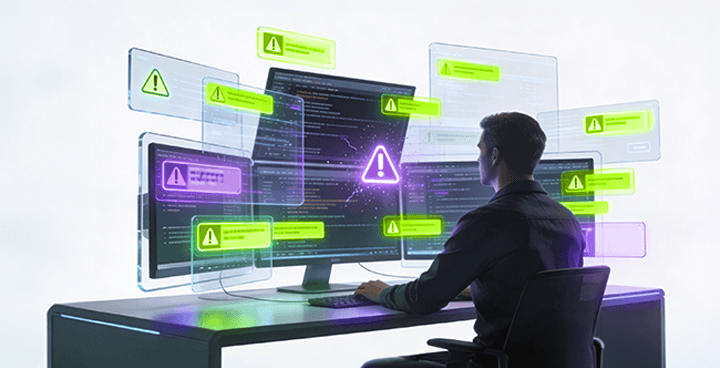
Table of contents
When Tools Become the Problem, Not the Solution
Numbers That Are Hard to Ignore
How the Pattern of Exhaustion Forms
Who Gets Hit Hardest in the Dev World?
The Darker Side: Attackers Who Deliberately Exploit This
When Alerts Were There — But Still Missed
What Can Actually Be Done?
Security Is About Attention, Not Tool Count
Tags:
Imagine this scenario. A ransomware alert arrives at 3:47 AM — buried under thousands of other notifications. An analyst finally sees it at 10:15 AM. Six hours after attackers had already finished exfiltrating client data [3]. This isn't fiction. It's the reality security teams face every single day.
When Tools Become the Problem, Not the Solution
For years, the default answer to digital security has always been: add more tools. More monitors, more scanners, more notifications. The result? Not better security — but increasingly overwhelmed teams.
This is what's known as alert fatigue: a state where security analysts receive so many notifications that they begin to go numb [5]. Not out of negligence, but because the human brain has its limits. When hundreds of alerts pour in every day, most of them start feeling identical — and the brain automatically begins treating all of them as background noise.
The phenomenon didn't actually originate in IT. It came from hospital emergency rooms, where nurses surrounded by constantly beeping patient monitors eventually stopped reacting — even to alarms signaling genuine emergencies [1]. Cybersecurity is experiencing exactly the same thing.
Numbers That Are Hard to Ignore
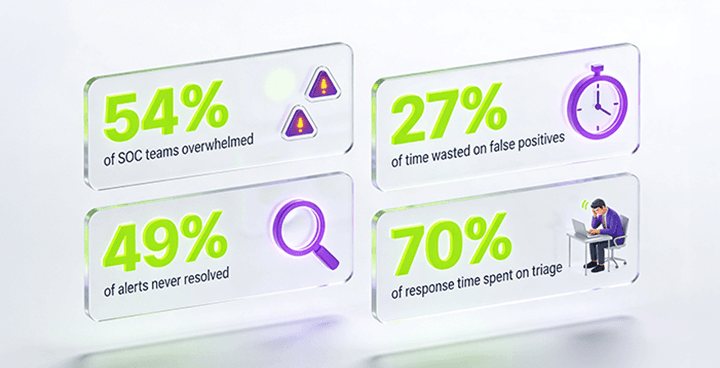
The situation is serious enough to be measured quantitatively.
A Trend Micro survey found that 54% of SOC teams feel overwhelmed by alert volume, with analysts spending an average of 27% of their working hours handling false positives — alerts that turn out to pose no real threat [1]. IBM, meanwhile, reported that teams are only able to resolve 49% of the alerts assigned to them in a single workday [6].
Gartner estimates that 70% of the threat detection and response cycle is spent in the triage and investigation phases alone — not in actually responding to threats [2].
And perhaps the most alarming figure: a Forrester analysis found that just three attack scenarios can trigger thousands of alerts [2]. Imagine a team that has to sort through all of that, every single day.
How the Pattern of Exhaustion Forms
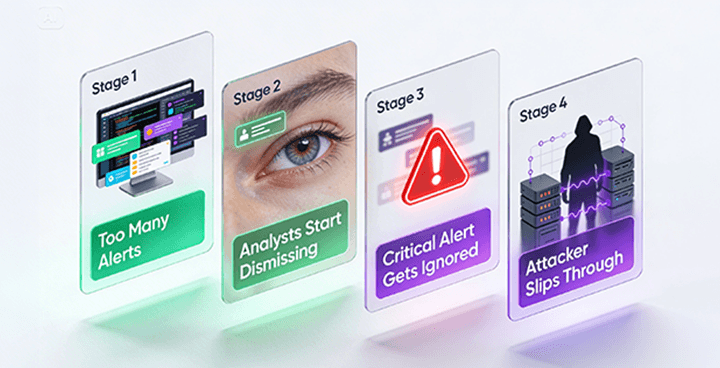
A SOC analyst interviewed in Daylight AI's research described it plainly [4]:
"Every morning you open your dashboard, see 200+ alerts from the weekend, and realize you're only going to look at the critical and high-severity ones. Everything else gets closed or ignored. You know some of those alerts might matter. You just don't have the time, the context, or the energy to find out."
Based on academic research from CSIRO, four root causes reinforce each other in a continuous loop [1]:
High false positive rates. This is the foundation of the entire problem. When more than half of all alerts turn out to be non-threats, analysts' trust in the monitoring system gradually collapses [1].
Fragmented and overloaded dashboards. Modern SOC teams manage an average of nearly 11 different security consoles, each with its own format, severity scale, and standards [6]. Correlating all of that manually is a task no human can do consistently at scale.
Shortage of skilled professionals. The global cybersecurity workforce gap spans millions of unfilled positions [3]. Fewer analysts must handle more alerts — and the cycle keeps spinning.
Inefficient standard operating procedures. Many teams still rely on manual processes that simply cannot keep pace with the speed of modern threats. Without proper automation and playbooks, response times slow and consistency breaks down [1].
Who Gets Hit Hardest in the Dev World?
Alert fatigue is often associated with SOC teams or dedicated security engineers. But as a developer — especially a fullstack one — you are not immune [3].
In a normal workday, you can be bombarded from multiple directions: linting warnings from your IDE, lengthy npm audit outputs, piling Dependabot pull requests, alerts from failing CI/CD pipelines, CORS errors in the browser console, and emails from a security scanner you barely remember setting up.
Everything feels important. But because everything arrives at once, nothing really gets proper attention.
This is where the gap opens. A critical vulnerability can slip through to production not because nothing detected it — but because the notification drowned in hundreds of other alerts that had already become routine to ignore [4].
The Darker Side: Attackers Who Deliberately Exploit This
Here's the part that rarely gets discussed: alert fatigue isn't just a byproduct of having too many tools. In some cases, it is a deliberately engineered attack strategy [5].
Palo Alto Networks notes that sophisticated threat actors understand this dynamic well. By flooding a target system with suspicious-looking but ultimately harmless activity, they create artificial noise — until the security team grows numb. Only then is the real attack launched, hidden within the commotion [5].
This isn't theoretical. Several major cybersecurity incidents throughout history trace back to the same pattern: the signal was there, but it sank before anyone could respond [6].
N-able's research reinforces this reality with a stark illustration: a ransomware alert buried at 3:47 AM, seen only at 10:15 AM — after the attackers were long gone. The tool worked. The alert fired. The breach still happened [3].
When Alerts Were There — But Still Missed
Alert fatigue becomes most dangerous not when alerts fail to trigger — but when they do, and still go unanswered. Across multiple major incidents, the pattern is disturbingly consistent.
In the Target data breach, advanced security systems flagged suspicious activity early. Alerts were generated as attackers moved through the network. But those signals weren’t acted on in time, allowing data exfiltration to continue undetected.
A similar breakdown appeared in the Equifax data breach. While often attributed to an unpatched vulnerability, the deeper issue was operational: critical signals failed to trigger timely action, exposing how detection without attention is ineffective.
The Anthem data breach followed the same pattern. Unusual database activity was detected, yet the alerts did not lead to immediate investigation. The result was one of the largest healthcare data breaches in history.
In the Capital One data breach, misconfiguration was the entry point — but not the whole story. Suspicious access patterns and warning signs existed before the breach was fully understood. Again, the gap between alert generation and human response proved critical.
Even outside cybersecurity, the consequences are well documented. Reports from The Joint Commission link dozens of deaths and serious injuries to missed or ignored medical alarms. In many cases, the systems worked exactly as designed — but constant exposure to non-critical alerts had desensitized the people responsible for responding.
Across industries, the conclusion is the same:
the system works, the alert fires — but the signal gets lost in the noise.
What Can Actually Be Done?
The answer isn't adding more tools. In fact, it's the opposite.
Audit what you already have. Of all the tools generating notifications in your workflow, which ones do you actually act on? If there's a tool you consistently skip, the problem may not be you — it may be that the tool is misconfigured and generating too much noise [2].
Separate severity levels with intention. CRITICAL should never appear in the same channel as INFO. When all alerts look visually equal, the brain assigns them all equally low attention [5].
Automate with precision, not volume. The goal isn't automation that generates more alerts — it's automation that filters the unnecessary ones. As CSIRO's research concludes, the most effective approach combines three lenses: automation for routine tasks, augmentation to support human decision-making, and human-AI collaboration for complex cases [1].
Build a "read before dismissing" culture. Something as simple as agreeing as a team: before closing an alert, read at least the first two lines. This small shift moves behavior from automatic-reactive to conscious-deliberate [4].
Qevlar AI's CEO Ahmed Achchak puts it well: reducing alert fatigue isn't about handling alerts faster. It requires changing how security operations work at a structural level — rethinking investigation workflows, not just adding more layers on top [2].
Security Is About Attention, Not Tool Count
In an era where every platform has a dashboard, every library has a vulnerability tracker, and every pipeline has its own notification system — the biggest temptation is to feel secure simply because you've installed a lot of things.
But as the data shows: alert volume has already dropped from 4,484 per day in 2023 to 2,992 in 2026 — yet the percentage going unaddressed remains stuck at 63% [6]. The problem isn't just quantity. It's signal quality and the human capacity to process it.
Real security isn't measured by how many tools are running. It's measured by how much genuine attention those alerts actually receive — and how quickly you can distinguish noise from a real threat [5].
Alert fatigue is a reminder that behind all the sophisticated technology, the last line of defense is still human. And humans, unlike servers, cannot simply be scaled up [1].
Reference
Tariq, S., Baruwal Chhetri, M., Nepal, S., & Paris, C. (2025). Alert Fatigue in Security Operations Centres: Research Challenges and Opportunities. ACM Computing Surveys, 57(9), Article 224. https://doi.org/10.1145/3723158
Achchak, A. (2026, March 25). Alert Fatigue in Cybersecurity: The Role of Automation [Interview]. ITSecurityWire.https://itsecuritywire.com/interview/alert-fatigue-cybersecurity-role-automation
N-able. (2026, February 14). Security Alert Fatigue in Cybersecurity: Causes, Impact & Solutions. N-able Blog.https://www.n-able.com/blog/alert-fatigue-cybersecurity
Shapira, H. (2026, February 27). What Is Alert Fatigue in Cybersecurity? Why More Visibility Doesn't Mean Less Work. Daylight AI Insights.https://daylight.ai/blog/alert-fatigue-in-cybersecurity
Palo Alto Networks. (2026). Guide: How to Reduce Security Alert Fatigue. Palo Alto Networks Resource Library.https://www.paloaltonetworks.com/cyberpedia/how-to-reduce-security-alert-fatigue
IBM Security. (2026). What Is Alert Fatigue? IBM Think Insights.https://www.ibm.com/think/topics/alert-fatigue
Tuned Security. (n.d.). The 2013 Target data breach: An analysis of one of the largest retail cyberattacks in history. Tuned Security.https://www.tunedsecurity.com/the-2013-target-data-breach-an-analysis-of-one-of-the-largest-retail-cyberattacks-in-history/
Security.org. (n.d.). Equifax data breach: What happened and what you should know. Security.org.https://www.security.org/identity-theft/breach/equifax/
Huntress. (n.d.). Anthem data breach. Huntress Threat Library.https://www.huntress.com/threat-library/data-breach/anthem-data-breach
Capital One. (2019). 2019 facts: Capital One data breach. Capital One. https://www.capitalone.com/digital/facts2019/
The Joint Commission. (2013). Medical device alarm safety in hospitals (Sentinel Event Alert, Issue 48).https://www.jointcommission.org/en-us/knowledge-library/newsletters/sentinel-event-alert/issue-48
Continue Reading
Alert Fatigue: The Silent Threat That Turns Critical Warnings into Background Noise
In the world of cybersecurity, alerts are meant to be the first line of defense against potential threats. However, the sheer volume of alerts that security teams receive can lead to a phenomenon known as alert fatigue, where analysts become desensitized to warnings and may miss genuine threats.
Read More

Security Awareness Training: Building a Culture of Cyber Resilience
Employees are often the weakest link in an organization's security system because they may forget important information and are vulnerable to fraud. Security awareness training helps employees understand the risks, threats, and vulnerabilities that can be targeted. This training teaches them how to protect the organization's network and data, especially for organizations operating in the IT sector, where employees who use devices are often the target of cyber attacks.
Read More

State of the Art: Architecture, Training, and Engineering of Large Language Models
The foundational pillar of modern Large Language Models (LLMs) rests upon the Transformer architecture, a computational paradigm that fundamentally altered natural language processing through the Self-Attention mechanism. Unlike recurrent networks that process data sequentially, Self-Attention allows every token within an input sequence to interact with all other tokens simultaneously. This generates a highly contextualized representation space capable of capturing long-range dependencies without rigid structural boundaries.
Read More
The Invisible Guard: How DMZs Protect the Modern Enterprise
Digitalization in the healthcare sector has been growing rapidly alongside the increasing adoption of information technology in healthcare services. The implementation of electronic medical records, online doctor consultation applications, and hospital queue management systems has significantly transformed healthcare delivery, making services more efficient and accessible for patients. However, this digital transformation also introduces new risks, particularly the rising threat to information security. This situation poses a serious challenge for the healthcare sector in the digital era, requiring organizations to establish, implement, and continuously improve information security management systems in a sustainable manner (Ansar, 2024).
Read More

ISO/IEC 27001: A Strategic Investment in Healthcare Security in the Digital Era
Digitalization in the healthcare sector has been growing rapidly alongside the increasing adoption of information technology in healthcare services. The implementation of electronic medical records, online doctor consultation applications, and hospital queue management systems has significantly transformed healthcare delivery, making services more efficient and accessible for patients. However, this digital transformation also introduces new risks, particularly the rising threat to information security. This situation poses a serious challenge for the healthcare sector in the digital era, requiring organizations to establish, implement, and continuously improve information security management systems in a sustainable manner (Ansar, 2024).
Read More

Large Language Model Vulnerabilities
With the integration of Large Language Models (LLMs) being commonplace in the workflows of enterprises across the globe, it is imperative that their vulnerabilities be known. Although developers use “System Prompts” to set behavioral guidelines for these models to safeguard confidential information, these directions are not foolproof.
Read More


© 2025 Tjakrabirawa Teknologi Indonesia. All Rights Reserved.